Ah, the hookshot.
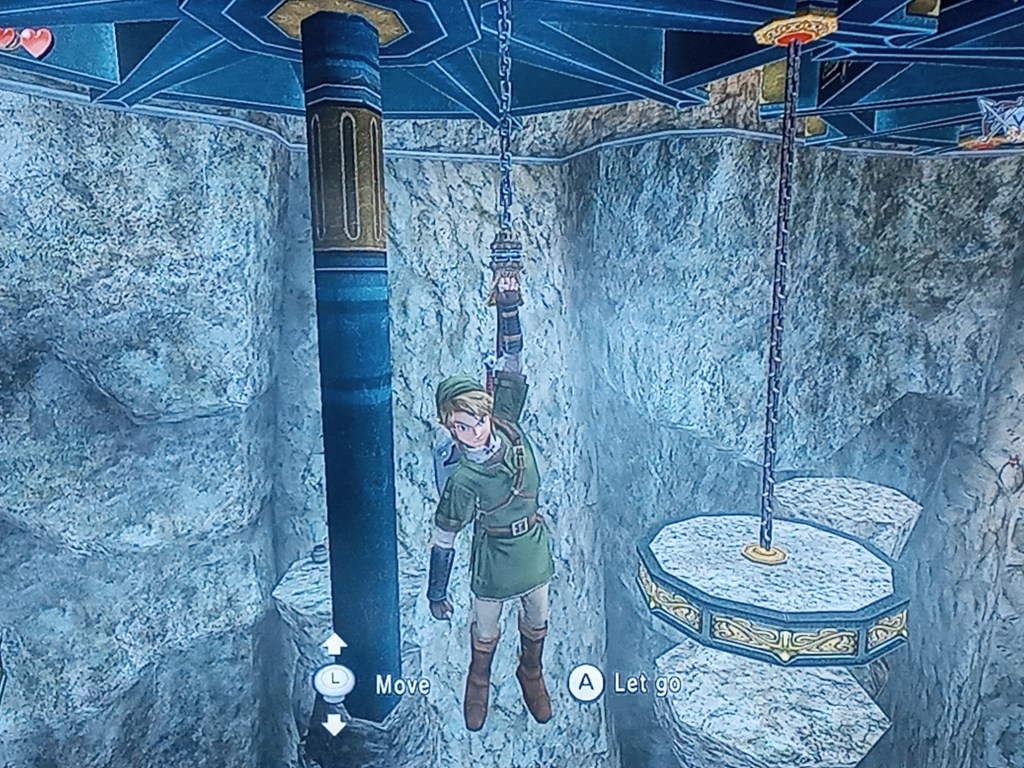
Above image: Link having way, way too much fun with the Clawshot in the Lakebed Temple.
In a recent playthrough of the Lakebed Temple (whose dungeon item is, of course, the Clawshot, being the Hookshot’s twin), my mind went to this Zelda staple item and all its iterations throughout the series.
So, I decided to break down each of this item’s appearances I’ve had the pleasure to play with in honour of this absolute classic item.
A brief note before I get into the meat of this post: while I am aware that the hookshot also makes an appearance in A Link Between Worlds, and the related ‘Gripshot’ appears in Tri Force Heroes, I have not played either of those games so I can’t attest to their value (or lack thereof).
The Original Hookshot: A Link to the Past
Ah, the very first instance of Link finding a hookshot in a water dungeon. While by no means the last time this sort of thing would happen in a Zelda game (the Water and Lakebed Temples saw to that) it was the first time it did, and since the hookshot is such a classic, iconic, cool and useful item I can’t say I’m sorry for it. It also plays a pivotal role in the boss fight—as dungeon items are wont to do the vast majority of the time—and overall clearly made enough of a splash in its first appearance to firmly affix itself as a series regular.
It has been some time since I’ve played this game, unfortunately, so I’m sure there’s several nuances in the hookshot’s functionality that I’m forgetting. Regardless of my incomplete recollection, however, it absolutely made history regarding this classic Zelda item and deserves recognition for it.
The Most Forgettable Hookshot: Link’s Awakening
Apparently there was a hookshot in Link’s Awakening. I think I remember it, but not very clearly. Anyways, according to the Zelda Encyclopedia it has the shortest range of any hookshot, so maybe it really just doesn’t warrant much memory.
I think you got it from the Stalfos in Catfish’s Maw?
I don’t remember.
The Most Versatile Hookshot: Ocarina of Time
The Hookshot/Longshot in Ocarina (along with its direct sequel counterpart, but more on that later)seems to be the one with the most use outside of pulling you to far away places. You might be asking—isn’t accessing difficult to reach places and clawing far away things closer to you what the hookshot is for? Yes, but in Ocarinait also doubles as a fairly solid projectile weapon that doesn’t need to constantly be refilled like the bow does. Sure, it doesn’t deal as much raw damage as the bow, but it’s also free to use. This thing’ll take down Skulltulas pretty quick if you catch them while they’re still hanging, and can in theory clear out Keese as well if you manage to catch them in one place. The Hookshot still works better than the bow for Keese, though, because at least you’re not tossing dozens of arrows out the window of the Fire Temple because those nasty Keese won’t stay still. (Fun fact: the Fire Keese in this dungeon, when all added up, did more damage to me than the boss Volvagia did.)
The hookshot is also invaluable—required, even—for killing Gold Skulltulas and even more so for snatching the tokens they leave behind. Pretty handy, if you ask me. There’s a lot of skulltulas you can’t even get until you pry the Hookshot out of Dampé’s cold, dead hands, which gives it a bonus in the category of usefulness.
Since I am proud to say I collected all 100 Gold Skulltula tokens, I put this iteration of the hookshot to good use.
The Longest Hookshot: Majora’s Mask
The Majora’s Mask hookshot is roughly as long as the ‘Longshot’ from Ocarina of Time without any need for upgrades. I know, it doesn’t sound quite as fancy as you might have been hoping for, but it’s a very healthy range for a hookshot. Once you get used to this one, you’ll find the others sorely lacking in the reach department.
Of course, since Ocarina and Majora share a great deal of assets, their hookshots are largely similar in their range of functions. However, I’ve played Majora far more recently and will therefore be able to go into a bit more detail; although it’s safe to assume that most, if not all, of what I say here regarding its function is also true of Ocarina’s hookshot.
This one is found in the Pirates’ Fortress mini dungeon, and also plays a large role in the following Great Bay Temple (much like the clawshots in Skyward Sword—more on them later). Much like its Ocarinacounterpart, it has a wide variety of uses, especially compared to that of later 3D entries.
First off, this hookshot has (as expected) a reasonable combat capability. It can kill the likes of Keese and Guays without using up any ammo, which isn’t a bad thing considering how much they move around. Sure, I may have missed my mark even locked on quite a few times, but at least missing was free. It can also kill small enemies the likes of Mini Babas instantly if you’re targeting them; it is also capable of one-shotting Skulltulas if you’re lucky enough their underside is turned towards you.
Link also makes good use of its ability to smash pots and crates in one hit—which to be fair is not a particularly noteworthy feature as most iterations are capable of this, but if I’m being perfectly honest with you Majora was the one game I went through and specifically noted all of its hookshot functions as I was playing for this post, so I’d be remiss to not mention it at all.
Another fun but not entirely noteworthy function that I’d like to mention is the fact that it can lop the tops off signposts. You can fix this error by whipping out your ocarina and playing the Song of Healing. This is an entirely irrelevant fact, but it’s a fun one I wanted to mention.
Another functionality that this hookshot boasts, one that’s sadly missing from later games, is the ability to hook onto treasure chests. I guess they removed this feature because of the potential to use it to cheese puzzles, but it sure would have been useful in Twilight Princess’ Lakebed Temple. This hookshot, much like the one in Wind Waker, can also latch on to certain trees, a critical function required to enter Ikana Canyon.
This hookshot also features what is arguably a better and more accurate aiming system than the bow’s. The red dot of the aiming target lines up with exactly where it’s going to fire, unlike the bow where you need to move the arrow significantly under the target to properly hit. It’s a bit crazy, but more than warrants praise and further solidifies the fact that the hookshot can and does replace the bow in certain areas of functionality during the playtime of both the N64 games (especially Ocarina, where Link actually gets it before the bow).
One final thing I need to mention before moving on: the design for this particular, Terminian iteration of the hookshot is notably very pretty and very unique. Compared to the previous hookshot it borrowed much (if not all) of its functions from, the design is far more striking, with a golden handle and tip and a stylish looking shape.
Taking into account all the features carried over from Ocarina, combined with the snazzy new design, I’d have to say that I find this to be one of, if not the best, most well-balanced hookshots to have appeared in the series. I have a lot to say about it, but like I said–I spent about sixteen hours in the three-day cycle running around trying to observe its capabilities for this very post.

Above image: Young Link holding a fine example of Terminian hookshot. I know the resolution is low, but trust me—it’s a hookshot.
The Prettiest Hookshot—The Wind Waker
It’s a shame you get the hookshot at almost the end of the Wind Waker (in the penultimate dungeon) and barely get a chance to use it, because it boasts both a long range and quite a pretty design. It’s pale blue, covered in wave designs, and covers Toon Link’s tiny hand a bit like a gauntlet.
However, I can’t say a whole lot regarding the hookshot’s functionality here because I got it so late I didn’t really use it much. Apparently it has a decent range—can’t attest to that—but aside from that I have no idea if it’s even good for offense.
There’s also the simple fact that the Grappling Hook, which is obtained very early on in the game, fills several of the traditional functions of the hookshot, and the merits of an ammunition-less infinitely usable weapon had already been supplied by the Boomerang, making the Hookshot, when you finally get it in the penultimate dungeon, the Wind Temple, even more obsolete.
The design of this hookshot is lovely, though; it’s not all negative. I just feel like it wasn’t fully utilized enough to be memorable, and as a result I simply don’t have much more to say about it.
However, it is the last hookshot in the series that is able to latch on to trees. I think that warrants comment.
The Most Prominent Hookshot: Twilight Princess
There are two games where acquiring the hookshot is a two-part process. I’ve already mentioned that Ocarina was the first, but even there the hookshot didn’t have the nerve to be the featured item in two different dungeons.
The Clawshots in Twilight Princess, on the other hand, absolutely did, and the gap between acquiring them makes the distance from Dampé’s grave to the fiendish Water Temple look like five minutes of gameplay.
I labeled it as the most prominent simply because it’s the main star of 25% of the game’s dungeons, which is a little crazy when you look at it statistically.
However, I was recently replaying Lakebed Temple (the first of the two Clawshot Dungeons) and found myself rather frustrated that I had to wait so long before I was able to function with both, knowing what lay ahead in Link’s journey.The City in the Sky is very far into the game, which means you spend an awful lot of time with just one clawshot, which defeats part of the purpose of giving Link two in the first place for most of the game—in my mind, anyway. Furthermore, there are several clawshot targets to be found in the overworld that can only lead you to where they ought to be taking you if you have both clawshots. This is endlessly frustrating on a replay when you know what you’re missing, but also downright baffling on your first play when you are unaware of the dual nature of this item, wondering why in Hylia’s name the clawshot target on the side of the rock is taking you absolutely nowhere with a view of nothing but a rock face and another clawshot target you can’t reach from anywhere.
Added on to this, the range isn’t particularly great, which can be frustrating when you’re trying to attach to the rotating targets in the Lakebed Temple.
However, somewhere along the line they removed the hookshot’s incredible ability to latch onto chests and haul you over. I’m not sure if this feature got lost in the Wind Waker, because as previously mentioned I never used the hookshot enough in Wind Waker to discover this.
Regardless, I remember aiming at a random small chest in the Lakebed Temple, only to find myself sorely disappointed as it refused to latch on.
While I may be complaining an awful lot about this clawshot, I want to make it clear that it also has several features that I really like. One unique thing about this clawshot is that it comes with the nifty function to allow Link to raise and lower himself along the chain.
This clawshot also has a few instances where it uses Link’s weight to activate switches in the ceiling, which is another fairly unique use of the device.
I think it also bears mentioning that while limited, the clawshot does have some combat merit. It can kill low-level enemies like chuchus and keese, and is even necessary to defeat foes like the common helmasaurs and the far less so chu worms (which can be defeated using other methods, but the clawshot is so easy and simple it’s not worth bothering). However, with that being said, it does little against hardier enemies like Tektites and Bokoblins. I wouldn’t praise it quite so highly as the N64 hookshots in the combat department, but it can hold its own nevertheless.
Overall, while lacking some of the previous hookshot features and having a frustratingly long gap between acquiring the initial clawshot and the upgrade, the Twilight Era clawshot is still quite a bit of fun.
The Most Generous Hookshot: Skyward Sword
Kind and generous Nayru gives you both clawshots simultaneously, this time. No slaving away with one clawshot with a poor reach for half the game like in Twilight Princess—no, you get them right after you clear the best of the game’s four Silent Realms, just in time for you to go full Spider-Link mode in the Lanayru Desert. Sure, you get them later on in the game than in Twilight, but at least you can immediately access their full range of ability.
These clawshots come roughly just past the halfway point in Skyward Sword, which means that while they aren’t necessarily the most crucial item in your arsenal, there are at least quite a few times where they are needed to proceed on your adventure. The Lanayru Sand Sea section in particular, which directly follows Link’s obtaining of the clawshots, makes quite heavy use of them. This isn’t particularly surprising given how the section right after obtaining an item in most Zelda games—whether it be in a dungeon or otherwise—usually places a heavy emphasis on said item.
So, while not necessarily the most memorable of hookshots, in part because they’re not the featured item of a dungeon, you do get both clawshots simultaneously and they’re moderately well-utilized in game, making them overall fairly balanced in the world of hookshots.
Of course, no post about the evolution of the hookshot would be complete without a mention of its absence from the newest two games. Sure, we have similar platforming and traversal mechanics like the incredible Paraglider, and the more recent additions of Ascend and Tulin’s Sage Vow; while none of these things act entirely in the fashion of the hookshot, they do something to fill the void it’s left (particularly Tulin).
However, the newer games don’t really need a hookshot in its old form. With the introduction of open world Hyrule, the ability to reach previously inaccessible areas isn’t quite as big a deal because, with the exception of Mount Agaat, nothing isinaccessible anymore in the way that used to make the hookshot necessary to pass. Sure, you could get some use out of a hookshot in the rain, but even that has been made less of a factor in Tears of the Kingdom with the introduction of the slip-resistance elixir and Froggy Armour with its set bonus.
With the paraglider and climbing, Link is freer than ever to explore the nooks and crannies of Hyrule. It’s because of this that I don’t believe the hookshot will be making another appearance in the near future, at least not in the same way that it has in previous games.
But it would still be wrong to dismiss the hookshot entirely, because without its help and foundation we may very well never have gotten the paraglider. Link’s tools are evolving, but we would be remiss if we failed to acknowledge the hookshot, one of the most frequently recurring items throughout the series, and also one of the coolest.
Let’s raise a glass—whether it be of Noble Pursuit or Lon Lon Milk—to the hookshot!

 The Nerdy Smial
Leave a reply to tudornerd Cancel reply